Saturday, February 26, 2005

paranoia agent

PARAnOiA AGeNT


Title: Mousou Dairinin (Japanese)
Director: Satoshi Kon
Character Design: Masahi Ando
Production : Madhouse Production

Visit Official Website

Genre
Psyche, suspense, horror (? a bit maybe...)

Synopsis (can't get more brief than this... quoted from www.animenewsnetwork.com )
A kid dubbed with the title "shounen bat" has been going around attacking people with bats. now two detectives are on the case to stop this kid from any more attacks... but they will find out soon enough, that this is much more than they can handle.

Director
alrite, let's get started. Paranoia agent is a TV anime series directed by the renowned director satoshi kon, who's credited for his ingenius movies such as 'perfect blue', 'millenium actress' and 'tokyo godfather'. Satoshi kon speaks the real hard truth in anime, not exaggerating, nor masking the thing we know so well as 'reality bites'.

Character Design
I wasn't aware of it until the name 'ando' caught my eye. Masahi Ando works for Ghibli as well. His style is, mmm, very realistic n comfortable to look at.

Infomation from www.animenewsnetwork.com

Madhouse Studio
www.madhouse.co.jp


---->Satoshi Kon


Tokyo Godfather is about three tramps (a girl who stabbed her own father when overtaken by rage, a transvestite who has a gentle heart and the dream to become a real woman ~_~, and a seemingly good-for-nothing guy who had a broken marriage). The unimaginable assembly of the threesome and their transient interaction with each other triggered by an abandoned baby bring us lots of surprises and warm reminders of how kindness still prevails even in the subzero city states that adopt us yet abandon us.

Camera zooms in. Big movie banner that says 'heaven's tears' and a huge crowd of people gathering on the floor, listening to priest's 'how God loves us' talk on CHristmas Eve.
Focus change. Top of the building, a girl pokes her head out of the safety bar and looks down on the dark crowd, then spits. Someone in the crowd who has been listening attentively jerks his head up as the spit hits him hard. But the girl already withdrew from his vision. All that is visible is the movie banner 'heaven's tears'. So it must be it. He wonders, eyes open wide, as the priest carries on with preaching.
Heaven's tears. In a cold hard city where people gather in search for love and truth.
My ass. Just a speck of spit. And streetcars buzz on.

That's Satoshi Kon you come to admire.

--->Paranoia Creeps in
What do u make out of the title? It's a psyche series, one that's full of deceits, illusions and hooks that set your mind on a frenzy search for the absolute truth which's somewhere far far away. I've only watched the first five episodes but from the rate of progress, the plot is getting more n more intangible as the no. of victims grow and so is the web of relations that pull these characters together.

Episode I Shounen Bat Has Arrived!!
Opening Theme
We see the main characters in the series laughing. Laughing laughing and laughing, as if seized by disease. THat's all they do, laugh.
No wonder it's called paranoia.

Noises, lots of noises. People shouting on mobile phones, cars and trucks horning away, congested subway trains rushing past. Graudually the noises mingle together until the cacophony is on the brink of exploading.
Then...
We see a senile patient scribbling strange characters on the ground of the hospital carpark. I don't understand Jap so I can only make out the last line 'blah blah = 510'
510 seems to be an omen, or an important clue.
In front of him, a commuter bus pulls to a hault. Through the window, we see a spectacled gir(Sagi Tsukiko). The old man gasps and looks alarmed.
It started out weird enough with a designer called Sagi Tsukiko who has her shot of fame when one of her designs becomes a fav. (if you ask me, japs they have sooo many funny little soft toys that look pitifully kawaii). Maromi is a gloomy looking girl who's taciturn and easily nervous. She always carries a soft toy with the name Dorubakon in her bag. She doesn't get along well with her collegues who are jealous of her talents and say harsh things behind her. And her all money-minded boss who thinks she could come up with money grossing designs overnight buggs her nonstop.
'With you magic!!'
'magic, magic, magic, i wish i have it...' mumbles Sagi as she walks home alone at night. An old lady who's picking through trash bags gives her creepy stares as Maromi walks past. There's something mysterious about the identity of this obasan. She's a tramp that camps around Maromi's apartment but disappears after the day of incidence. Alrite, so Sagi is scared and starts running as the street lights turn out one by one and dark shadows slowly devour the space and creeps in on her (paranoia!!) In the utter panic Maromi trips and falls, spilling the contents carried in her handbag. Scraps of designs are scattered all over the ground . She presses herself onto the ground and extendes her arm as far as possible in order to fetch a design that gets lodged beneath the car base and just as she straightens up, a shadowy figures looms out of nowhere and attacks her with a bag. The next morning, she's in hospital with two detectives in charge of the assault. One of them has a quick temper that simply explodes in front of witnesses who refuse to speak. The other is extremely patient and gentle. In the end, they gather that the assailant is a primary school kid with a baseball cap and attackes people with a crooked baseball bat. Back in her room, Sagi is scanning the msgs posted in her fan forum. One post which reads ' you're attacked by the shounen with the golden bat...' scares her and her pet toy Dorubankon slips off her lap as she shivers. The scary thing is not about the threatening post in the forum. It's the pet toy. Dorubankon speaks !! n moves!!! utter horror! I have no idea whether it's a ghost from Sagi's own paranoic imagination or plain fact.

An annoying freelancer who wants to write sensational stories out of the incidence traces Sagi down like a pervert dog. Yaks, he's so disgusting. All he thinks about is sex and money. One day when he is chasing after Sagi, the shounen bat appears and attacks him in the same way he does to Sagi.

Second Victim.
End of Episode I.

Tidbit of Episode I
The ringtone played as Sagi crosses the road and bumps into the annoying writer is exactly the same as that used in 'Beyond - Animatrix'. And it sounds horribly paranoia!

The trick about this anime series is, you stop believing in anything you see coz they could all be figments of imagination and the series is in totaly anacrhonistic chaos. Flashes of scenes that take place in different places and time and only give you an abstract and nonetheless eerie feeling of what indeed happens, and all those weird characters, existent or non-existent!!

to be c'td

Sunday, February 06, 2005

oscar05

Check it out!
AWN holds a special animation oscar 05 showcase site
http://www.awn.com/oscars05/

walt disney

Walt Disney - The Visionary and Father of Animation

Disclaimer: all information obtained from Walt Disney Official Site

"We have created characters and animated them in the dimension of depth, revealing through them to our perturbed world that the things we have in common far outnumber and outweigh those that divide us."
- Walt Disney

Detailed Biography
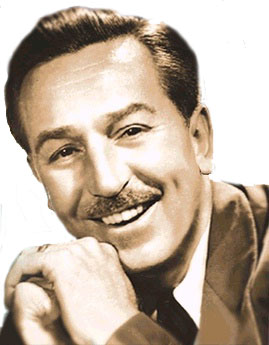


Try to imagine a world without Walt Disney. A world without his magic, whimsy, and optimism. Walt Disney transformed the entertainment industry, into what we know today. He pioneered the fields of animation, and found new ways to teach, and educate.

Walt's optimism came from his unique ability to see the entire picture. His views and visions, came from the fond memory of yesteryear, and persistence for the future. Walt loved history. As a result of this, he didn't give technology to us piece by piece, he connected it to his ongoing mission of making life more enjoyable, and fun. Walt was our bridge from the past to the future.

During his 43-year Hollywood career, which spanned the development of the motion picture industry as a modern American art, Walter Elias Disney established himself and his innovations as a genuine part of Americana.


A pioneer and innovator, and the possessor of one of the most fertile and unique imaginations the world has ever known. Walt Disney could take the dreams of America, and make them come true. He was a creator, a imaginative, and aesthetic person. Even thirty years after his death, we still continue to grasp his ideas, and his creations, remembering him for everything he's done for us.


Walter Elias Disney was born on December 5, 1901 in Chicago Illinois, to his father, Elias Disney, an Irish-Canadian, and his mother, Flora Call Disney, who was of German-American descent. Walt was one of five children, four boys and a girl.

Later, after Walt's birth, the Disney family moved to Marceline, Missouri. Walt lived out most of his childhood here. Walt had a very early interest in drawing, and art. When he was seven years old, he sold small sketches, and drawings to nearby neighbors. Instead of doing his school work Walt doodled pictures of animals, and nature. His knack for creating enduring art forms took shape when he talked his sister, Ruth, into helping him paint the side of the family's house with tar.

Close to the Disney family farm, there were Santa Fe Railroad tracks that crossed the countryside. Often Walt would put his ear against the tracks, to listen for approaching trains. Walt's uncle, Mike Martin, was a train engineer who worked the route between Fort Madison, Iowa, and Marceline. Walt later worked a summer job with the railroad, selling newspapers, popcorn, and sodas to travelers.

During his life Walt would often try to recapture the freedom he felt when aboard those trains, by building his own miniature train set. Then building a 1/8-scale backyard railroad, the Carolwood Pacific or Lilly Bell.

Besides his other interests, Walt attended McKinley High School in Chicago. There, Disney divided his attention between drawing and photography, and contributing to the school paper. At night he attended the Academy of Fine Arts, to better his drawing abilities.

Walt discovered his first movie house on Marceline's Main Street. There he saw a dramatic black-and-white recreation of the crucifixion and resurrection of Christ.

During these "carefree years" of country living young Walt began to love, and appreciate nature and wildlife, and family and community, which were a large part of agrarian living. Though his father could be quite stern, and often there was little money, Walt was encouraged by his mother, and older brother, Roy.

Even after the Disney family moved to Kansas City, Walt continued to develop and flourish in his talent for artistic drawing. Besides drawing, Walt had picked up a knack for acting and performing. At school he began to entertain his friends by imitating his silent screen hero, Charlie Chaplin. At his teachers invitation, Walt would tell his classmates stories, while illustrating on the chalk board. Later on, against his fathers permission, Walt would sneak out of the house at night to perform comical skits at local theaters.

During the fall of 1918, Disney attempted to enlist for military service. Rejected because he was under age, only sixteen years old at the time. Instead, Walt joined the Red Cross and was sent overseas to France, where he spent a year driving an ambulance and chauffeuring Red Cross officials. His ambulance was covered from stem to stern, not with stock camouflage, but with Disney cartoons.

Once he returned from France, he wanted to pursue a career in commercial art, which soon lead to his experiments in animation. He began producing short animated films for local businesses, in Kansas City. By the time Walt had started to create The Alice Comedies, which was about a real girl and her adventures in an animated world, Walt ran out of money, and his company Laugh-O-Grams went bankrupted. Instead of giving up, Walt packed his suitcase and with his unfinished print of The Alice Comedies in hand, headed for Hollywood to start a new business. He was not yet twenty-two.

The early flop of The Alice Comedies inoculated Walt against fear of failure; he had risked it all three or four times in his life. Walt's brother, Roy O. Disney, was already in California, with an immense amount of sympathy and encouragement, and $250. Pooling their resources, they borrowed an additional $500, and set up shop in their uncle's garage. Soon, they received an order from New York for the first Alice in Cartoonland(The Alice Comedies) featurette, and the brothers expanded their production operation to the rear of a Hollywood real estate office. It was Walt's enthusiasm and faith in himself, and others, that took him straight to the top of Hollywood society.

Although, Walt wasn't the typical Hollywood mogul. Instead of socializing with the "who's who" of the Hollywood entertainment industry, he would stay home and have dinner with his wife, Lillian, and his daughters, Diane and Sharon. In fact, socializing was a bit boring to Walt Disney. Usually he would dominate a conversation, and hold listeners spellbound as he described his latest dreams or ventures. The people that where close to Walt were those who lived with him, and his ideas, or both.

On July 13, 1925, Walt married one of his first employees, Lillian Bounds, in Lewiston, Idaho. Later on they would be blessed with two daughters, Diane and Sharon . Three years after Walt and Lilly wed, Walt created a new animated character, Mickey Mouse.

His talents were first used in a silent cartoon entitled Plane Crazy. However, before the cartoon could be released, sound was introduced upon the motion picture industry. Thus, Mickey Mouse made his screen debut in Steamboat Willie, the world's first synchronized sound cartoon, which premiered at the Colony Theater in New York on November 18, 1928.

Walt's drive to perfect the art of animation was endless. Technicolor was introduced to animation during the production of his Silly Symphonies Cartoon Features. Walt Disney held the patent for Technicolor for two years, allowing him to make the only color cartoons. In 1932, the production entitled Flowers and Trees won Walt the first of his studio's Academy Awards. In 1937, he released The Old Mill, the first short subject to utilize the multi-plane camera technique.

On December 21, 1937, Snow White and the Seven Dwarfs, the first full-length animated musical feature, premiered at the Carthay Theater in Los Angeles. The film produced at the unheard cost of $1,499,000 during the depths of the Depression, the film is still considered one of the great feats and imperishable monuments of the motion picture industry. During the next five years, Walt Disney Studios completed other full-length animated classics such as Pinocchio, Fantasia, Dumbo, and Bambi.

Walt rarely showed emotion, though he did have a temper that would blow over as it blew up. At home, he was affectionate and understanding. He gave love by being interested, involved, and always there for his family and friends. Walt's daughter, Diane Disney Miller, once said:

Daddy never missed a father's function no matter how I discounted it. I'd say,"Oh, Daddy, you don't need to come. It's just some stupid thing." But he'd always be there, on time.
Probably the most painful time of Walt's private life, was the accidental death of his mother in 1938. After the great success of Snow White and the Seven Dwarfs, Walt and Roy bought their parents, Elias and Flora Disney, a home close to the studios. Less than a month later Flora died of asphyxiation caused by a faulty furnace in the new home. The terrible guilt of this haunted Walt for the rest of his life.

In 1940, construction was completed on the Burbank Studio, and Disney's staff swelled to more than 1,000 artists, animators, story men, and technicians. Although, because of World War II 94 percent of the Disney facilities were engaged in special government work, including the production of training and propaganda films for the armed services, as well as health films which are still shown through-out the world by the U.S. State Department. The remainder of his efforts were devoted to the production of comedy short subjects, deemed highly essential to civilian and military morale.

Disney's 1945 feature, the musical The Three Caballeros, combined live action with the cartoon animation, a process he used successfully in such other features as Song of the South and the highly acclaimed Mary Poppins. In all, more than 100 features were produced by his studio.

Walt's inquisitive mind and keen sense for education through entertainment resulted in the award-winning True-Life Adventure series. Through such films as The Living Desert, The Vanishing Prairie, The African Lion, and White Wilderness, Disney brought fascinating insights into the world of wild animals and taught the importance of conserving our nation's outdoor heritage.

Walt Disney's dream of a clean, and organized amusement park, came true, as Disneyland Park opened in 1955. As a fabulous $17-million magic kingdom, soon had increased its investment tenfold, and by the beginning of its second quarter-century, had entertained more than 200 million people, including presidents, kings and queens, and royalty from all over the globe.

A pioneer in the field of television programming, Disney began television production in 1954, and was among the first to present full-color programming with his Wonderful World of Color in 1961. The Mickey Mouse Club was a popular favorite in the 1950s.
But that was only the beginning. In 1965, Walt Disney turned his attention toward the problem of improving the quality of urban life in America. He personally directed the design of an Experimental Prototype Community of Tomorrow (EPCOT). It was planned as a living showcase for the creativity of American industry. Disney said this about EPCOT:

I don't believe there is a challenge anywhere in the world that is more important to people everywhere than finding the solutions to the problems of our cities. But where do we begin? Well, we're convinced we must start with the public need. And the need is not just for curing the old ills of old cities. We think the need is for starting from scratch on virgin land and building a community that will become a prototype for the future.

Thus, Disney directed the purchase of 43 square miles of virgin land--twice the size of Manhattan Island--in the center of the state of Florida. Here, he master planned a whole new "Disney world" of entertainment to include a new amusement theme park, motel-hotel resort vacation center, and his Experimental Prototype Community of Tomorrow. After more than seven years of master planning and preparation, including 52 months of actual construction, the Walt Disney World Resort, including the Magic Kingdom Park, opened to the public as scheduled on October 1, 1971. EPCOT Center opened October 1, 1982, and on May 1, 1989, the Disney-MGM Studios Theme Park opened.


A few years prior to his death on December 15, 1966, Walt Disney took a deep interest in the establishment of California Institute of the Arts, a college-level professional school of all the creative and performing arts. CalArts, Walt once said, "It's the principal thing I hope to leave when I move on to greener pastures. If I can help provide a place to develop the talent of the future, I think I will have accomplished something."


The California Institute of the Arts was founded in 1961 with the combination of two schools, the Los Angeles Conservatory of Music and the Chouinard Art Institute. The campus is located in the city of Valencia, 32 miles northeast of downtown Los Angeles. Walt Disney conceived the new school as a place where all the performing and creative arts would be taught under one roof in a "community of the arts" as a completely new approach to professional arts training.


Walt Disney is a legend; a folk hero of the 20th century. His worldwide popularity was based upon the ideals which his name represents: imagination, optimism, creation, and self-made success in the American tradition. Walt Disney did more to touch the hearts, minds, and emotions of millions of Americans than any other person in the past century. Through his work he brought joy, happiness, and a universal means of communication to the people of every nation. He brought us closer to the future, while telling us of the past, it is certain, that there will never be such as great a man, as Walt Disney.

Walt Disney at work [explaining storyboards]
- He's a true comedian.


Disney Feature Films [not updated]
Walt Disney Full Length
Animated Features

1. Snow White and the Seven Dwarfs, 1937.
2. Pinocchio, 1940.
3. Fantasia, 1940.
4. Dumbo, 1941.
5. Bambi, 1942.
6. Saludos Amigos, 1943.
7. The Three Caballeros, 1945.
8. Make Mine Music, 1946.
9. Fun and Fancy Free, 1947.
10. Melody Time, 1948.
11. The Adventures of Icabod and Mr. Toad, 1949.
12. Cinderella, 1950.
13. Alice In Wonderland, 1951.
14. Peter Pan, 1953.
15. Lady And The Tramp, 1955.
16. Sleeping Beauty, 1959.
17. 101 Dalmations, 1961.
18. The Sword And The Stone, 1963.
19. The Jungle Book, 1967.
20. The Aristocats, 1970.
21. Robin Hood, 1973.
22. The Many Adventures Of Winnie The Pooh, 1977.
23. The Rescuers, 1977.
24. The Fox And The Hound, 1981.
25. The Black Cauldron, 1985.
26. The Great Mouse Detective, 1986.
27. Oliver & Company, 1988.
28. The Little Mermaid, 1989.

After The Little Mermaid, Walt Disney Productions switched from hand drawing and painting their animation to a new computerized system, called "CAPS,"which stands for Computerized Animation Production System.

29. The Rescuers Down Under, 1990.
30. Beauty And The Beast, 1991.
31. Aladdin, 1992.
32. The Lion King, 1994.
33. Pocahontas, 1995.
34. The Hunchback Of Notre Dame, 1996.
35. Hercules, 1997.
36. Mulan, 1998.
37. Tarzan, 1999. (Released June 18th, 1999)


Animation historians love to say "It all started with a mouse". In fact it actually began with a visionary named Walt Disney.

From the early years in Kansas City with the likes of Ub Iwerks, Hugh Harmon and Rudy Ising. Walt Disney went on to become the single most important man in the history of animation. His legacy is a veritable who's who of animated characters; Snow White, Donald Duck, Pinocchio, Alice, Bambi, Cinderella, and of course, Mickey Mouse.


The Process of Animation
[note: just a GENERAL process. there're vast variations b/w japanese animation and western ones.]

1. A storyboard is made, all the animators and directors come together to discuss the entire film.

2. The storyboards are presented as the story

3. Once the story is laid out, the dialogue is recorded. This is done before animation, so the animators know what the characters will say.

4. After the dialogue is recorded, the animators can make rough sketches of just the characters. Usually these drawings are quite messy, there is still no color, or background. Some animated films have used over 50,000 individual drawings.


At most animation studios, the best animators only sketched a few animation drawings, leaving gaps in between. Later on, a person called an "inbetweener" would finish the scenes, by drawing in between the areas that the animator had left.

5. Once the entire film has been drawn on paper, the animation drawings go to the inking department. There, the inkers copy the animation drawings on to a clear celluloid acetate, sometimes called a Cel.

6. After the outline of the characters has been made, the unfinished Cel's go to the Painting Department. The painters flip the Cel over, and paint the colors on the back. They paint on the back so the characters appear crisp, and have an outline.

7. Before the Animation Cels get photographed a background must be added. Because a Cel is clear, and it only has the painted character on it, if a background is made, it will show through. Usually backgrounds are painted with Tempera or Water Color paint. Although, in some Disney productions, the background was painted on glass, and combined with other glass painted backgrounds to create the illusion of extreme movement. (This technique is use in Snow White and the Seven Dwarfs.)

8. Now all the combined elements (the Cel and the background) can be photographed. Although, the final product is not filmed with a normal projector, or camera. A special device, with a lens mounted facing down on to a table top captures each frame of the animated feature. Usually, the background is placed into a special mount, then covered with the Cel, then covered with a large piece of glass, then photographed.

9. After all the drawings have been filmed, the dialogue is added. Sometimes the film is edited at this step.

10. The animated film is released, and the general public may view it.


cowboy bebop

Cowboy bebop
- a complete review

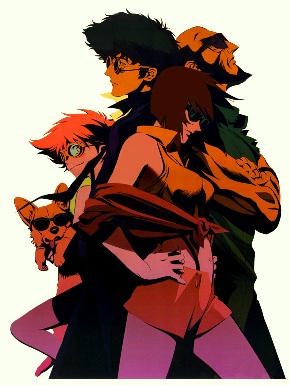
Why is the renowned animation TV series called 'cowboy bebop' in the first place. It gives some people the impression of a big farm, bull riding and flying loops which of course don't appeal to us as much. Cowboy bebop, as the screen dub says in the opening episodes, is about a new genre of jazz that defies convention and age. Also, it's the name of the fishing ship Jet owns, a rather dilapidated n worn down ship on which the cowboys dwell. Cowboy is not only about Spike Spiegel. They're the awesome fours, Spike, Jet, Ed and Faye. [sorry i have to disclude the cutie data dog Ein, since he can't talk]

Once upon a time, in New York City in 1941... at this club open to all comers to play, night after night, at a club named "Minston's Play House" in Harlem, they play jazz sessions competing with each other. Young jazz men with a new sense are gathering. At last they created a new genre itself. They are sick and tired of the conventional fixed style jazz. They're eager to play jazz more freely as they wish then... in 2071 in the universe... The bounty hunters, who are gathering in the spaceship "BEBOP", will play freely without fear of risky things. They must create new dreams and films by breaking traditional styles. The work, which becomes a new genre itself, will be called... COWBOY BEBOP


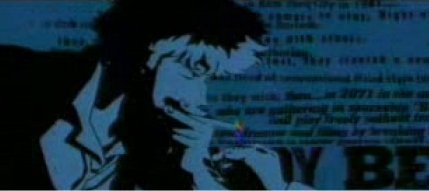
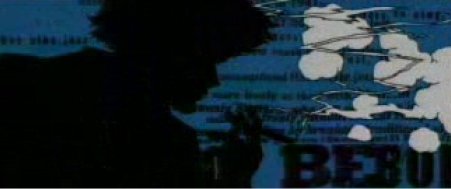
Cowboy bebop is a concoction of sci-fi, modern jazz, action, thrill and melancholy. Opening theme 'tank!' is a total blow away. Jazzy blue and bloody red and characters inked against smoking guns. The almost nasal drumbeats 'du la ba' tinkles every sinew and nerve. It's almost modern art judging from the choice of colours. Like what Munch[please imagine double dots on the 'u'] mentioned about a billiard room, the light was dim and idle players lazed about, chatting and smoking. You thought it was burnt candle light and grey but after a drink, you put down your glass of pint and jerked up your sleepy head, it wasn't any colour. It was blood red and green. That's the touch closest to the bebop funk.

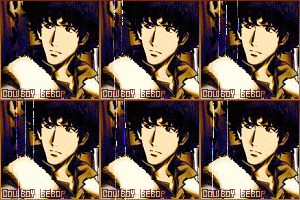
Screen grabs from the opening theme 'tank!'


Lyrics composed by Jim Jensen [a v. good lyricist as i've come to notice] in the cowboy bebop movie - knocking on heaven's door best describe the detachment, mockery and apathy in the 'real folk blues'.
'Come to brain dead, can't decide...Ask your conscience the why and how, do it right, do it wrong or do it now'
'Happiness is just a word to me, it might have meant a thing or two if i'd have known the difference'
Don't mistake it for a pessimistic movie that merely whines about the thorns of life. It's a matter of CHOICE of the way to live a life as entitled by every free human being. Fires that burn bright still and scotch the scars that can never heal, stoned hearts sink into hibernation until brutally awoken by thousand stomps that shatter the sanctuary, or a yearning that's been searching for its echo since the day stars adorned the sky. Every single one of them LOVES life but how badly wounded they're in the long ride. You lay down your cigar n hiss 'C'est la vie'. Not much different eh? Even in the cosmo year of 2050. 'Just another smoking gun, a sign of my indifference' It's real. It's blue. It's human. It's every piece of us.

Never seen a sky so blue
Life is just a dream you know
Don't wake me up from my dream
It's really everything it is
I'm ascending
among the stars
they really aren't so far
no black and white in the blue

-[Blue]


Space Cowboys

Spike Spiegel

Mushroom hair, cigarette butts, brown eyes of slightly different shades, blue suit, sleeves round up to elbow, slouching back, sleepy face.
'Yo!'
Spike comes across as a lazy character. The way he drags himself with hands stuck in pockets, mushroom hair that rids of all necessity for extra combing n styling, lanky body that leaves long dark shadows on the pavements. This is the 'present spike', a man who hides his past and chooses to live a rather 'aimless' life as a bounty hunter. I doubt he knows any real happiness although the temporary dysfunctional family he has - Jet, Faye, Ed & Ein gives him some comfort but when the shadows of past catch up with him, Spike is no longer the laid back careless person we know. He falls silent and appears very much alone again.

Basic Facts about Spike

->Height: 185cm
->Birth place: Mars
->B-day: June 26, 2044 (Gemini)
->Age: 27

->Skills:
highly competent at hand to hand combat (he trains a lot obviously. I'm not sure if all the martial art movements are reminiscent of Bruce Lee, since the director Watanabe seems to be a big fan. In session#8 Waltz for Venus, Spike teaches Roco some basic combat skills and the foundamental principles Spike expounds on seem to come from taichi - how one visualizes movements as a flowing body of water, and that instead of opposing ur opponent's attack with brutal force, you should take advantage of his strength and make it ur own.)
smart
lots of stealthy movements ^_^ (in session #5 Ballad of the Fallen Angel, he manages to throw a hand dynamite at Vicious even in the kind of situation where he's falling from the church top and shards r flying around, and in session #4 Gateway Shuffle, he slips the virus vile into the terrorist woman's pocket. nobody noticed obviously...)
History: used to be in a syndicate called 'Red Dragon'. later quit and lead the life of a bounty hunter

->Hates
Tomboys (Faye that is), beasts (poor Ein...) & Rugrats (hoho Ed...)

From the end of session #9 Jamming with Edward
SPIKE: Hey, Jet, did you know that there are three things that I hate?
JET: Whatever...
SPIKE: Rugrats... beasts... and tomboys.
JET: Oh?
SPIKE: Don't give me that! Why do we have all three neatly gathered here?!

Also hates Andy Von De Oniyate (a true western cowboy, from session #22 Cowboy Funk. Andy's a dumb ass cowboy who loves to boast n show off, somewhat like Spike except Spike's way much smarter. Spike got stomped by Andy's horse hahahaha I can't help laughing about it.)

End of #22 Cowboy Funk
The Bebop. Spike eats large spoonfuls of "SON-OF-A-GUN STEW."
[note: this stew is a product of Andy..., brought home in bountiful by Faye]
SPIKE: Well, it was only a rich boy's hobby. His level, no, rank was really
no match for me. Hey, are ya listening?
JET: Yeah, yeah.
SPIKE: So, he just wasn't any enemy of mine. Of course, I never had him in
my line of sight. Hey, are ya listening?
JET: Yeah, yeah.

->Loves
What does Spike like? HMM, this's a tough question. We all know Spike loves Julia, but what else? Possible contenders:
Food, esp. prairie oyster-mixing gin, egg yolk, hot sauce, and pepper.According to Spike himself, prairie oyster's good for hangovers.
(from session#7 Heavy Metal Queen, thanx to TV scripts compiled by the webmaster of The Real Folk Blues, a truly wonderful & professional cowboy bebop fan site.)
Pool games
Well, I'm not sure about this one. Maybe Spike plays pool to kill time. We know that Spike met Julia when he was playing pool. And in session#20 Pierrot le Fou, he was also playing pool at a bar called 'c'est la vie', and appeared to be an extremely skilled player. Well, Spike's good at almost everything so to speak... anime characters are more or less perfect.
cigarretes
smoker, hopeless

->Relationships
with Vicious: used to be borther in arms way back in the syndicate. but later there's only hatred n desire for revenge. Possibly because of Julia who was initially Vicious' lover but 'betrayed' him n chose Spike. Personally I think Julia's not the major reason. Vicious has a very dark personality and the only thing he values is power. He'd kill anyone who gets in his way. Vicious said that he's the only person who could kill Spike and that they had the same blood running inside them.(in session#5 Ballad of the Fallen Angel) The first part is true, as in they killed each other in the end. For the latter part however, Spike tossed his past behind him and severed all ties with the syndicate, including Vicious. Quoting Spike, 'I've bled all of that blood away'.
In a word, they're the death of each other.

with Julia: the lovers. Spike was astounded by Julia's beauty when he first saw her in the club where they played pool. It was love at first sight. In flashback scenes, it seems that Spike was severely wounded in a mission. Bleeding all over as he was, he stumbled upon Julia's house in his little leftover consciousness. Julia nursed him back to health and was seen humming a gentle tune while Spike was still in his somber state. That's probably where it all started. But Julia is Vicious' lover and this love triangle isn't going anywhere. Spike asked Julia to elope with him, to escape to a place where nobody would trouble them, to leave the whole syndicate thing behind. Julia hesitated because she knew Vicious would never let them free. Spike came up with a plan: he would feign death after one last assignment and Julia would meet him at the decided place and they would run away together. Spike gave her a piece of paper with the secret address written on it. That fateful night, Spike waited in the rain with a bouquet of roses for his lover who never came. From that day one, Spike became another person, lived another life, a bounty hunter. Obviously he didn't know what happened to Julia who later disappeared from the syndicate. It is only in the grand ending episodes that we're told Vicious threatened Julia with a gun 'either both of you die or you kill him yourself'. Julia didn't kill Spike and coz of that, she was forever chased by the syndicate, a life on the run. In the last episode, Julia met Spike again, the moment of reunion filled with complicated feelings. And transient promise of happiness just to be shattered once more. In a gunfire, Julia was shot in the back. It was a rainy day. Spike cuddled Julia close in his arms.
'This is ... a dream...'
'Yeah... just a bad dream'

with Jet: They're the perfect partners. Jet used to be a cop but quit his job after an accident which severed his left arm. The cowboys used to be Jet n Spike but later Ed and Faye joined them on the fishing ship and together they kicked off a wonderful bounty hunting team, although it seems that they each has their own best interest at heart and money is all that matters ^_^ Jet probably knows Spike best if not counting people from Spike's past. Jet is like the big brother who takes care of everyone althou it's not his character to display his caring nature so openly. Spike often critizes Jet's cooking.
In episode#1 Asteroid Blues,
JET: Hey, Spike! It's ready!
SPIKE: I'm just about done myself. What's cooking?
JET: Special, "Qing-jiao-rou-si." (Beef with bell peppers)
The living room.
JET: Asimov Solensan. This is our next target.
SPIKE: Hey, Jet...
JET: He's a high-end of the syndicate that deals all around the asteroids.
SPIKE: About this "Qing-jiao-rou-si..."
JET: This guy's name is Asimov Solensan. Weren't you listening to me?!
SPIKE: You DON'T call a meatless "beef with bell peppers" "beef with bell
peppers"... do you?
JET: Yes, you do.
SPIKE: No, you don't!
JET: You do when you're broke!
SPIKE: What happened to the 1 million Woolongs we got as bounty from that
last guy?!
JET: The repair bill the plane you wrecked and the repair bill for the shop
you trashed and the medical bill for the cop you injured KILLED ALL
THE DOUGH!

Now you see how those two get along/put up with each other. In the final session, Spike came back to the ship for one last time. They had the last meal together. It was a quietly moving scene. Their merry laughters hardly covered their unmeasurable sorrows. Jet knew he wasn't able to hold Spike back coz he only knew Spike too well. And he knew he would lose him. But he couldn't ask Spike to stay.

The Bebop. Jet awakes from a nap on the couch and sees Spike.
JET: Spike, you...
Spike smiles.
SPIKE: Do you have anything to eat? I'm starving.
Jet serves up a plate of bell peppers.
SPIKE: The food you cook tastes horrible, as usual.
JET: For that, you sure are eating a lot.
SPIKE: Hunger is the best spice, they say.
Spike finishes the meal.
SPIKE: Do you know a story that goes like this? There once was a tiger-
striped cat. This cat died a million deaths and was reborn a million
times and was owned by various people who he didn't care for. The
cat wasn't afraid to die... One day, the cat was a free cat, a stray
cat. He met a white female cat, and the two cats spent their days
happily together. Years passed, and the white cat died of old age.
The tiger-striped cat cried a million times, and then died. It never
came back to life...
JET: That's a good story...
SPIKE: I hate that story. I hate cats.
JET: That's what I thought.
The two laugh for a good while. Spike gets up and begins to walk away.

Men never cry. He laughs. He laughs. They laugh to hide their tears.What liars.

with Faye: They're the eternal enemies. As said, Spike totally dispises 'tomboy'. Faye pisses him off. They constantly fight over food, money(Faye wastes most of it on gambling), and bounties. Even when Spike is moribound (the 'renowed mummy' in session #5 & #20), Faye never shows any gentle caring nature typical of a normal woman. Despite all these, we see sparks of hope passing between the two. Is it possible that a relationship will grow?
There're several occasions where Faye lets her thoughts slip. In sessoin#20, Spiked said 'this's probably gonna be the death of me' after he received the invitation from the man-killing machine Tongpu and he asked Faye 'will you come and rescue me?', Faye looked away and muttered 'baka(fool)'and indeed she went there to help Spike although her spaceship was crashed and herself trapped.
And it's also quite obvious that Faye was struck by a pan of jealousy when Julia asked her to deliver a message to Spike.
Well, a sign and head shakes to all the faye-spike supporters out there. They're probably the last possilbe match in the whole universe. The feeling Faye has towards Spike is more like family instead of opposite attraction. In the last episode when Spike bid goodbye and walked away, Faye stopped him and told him she had already lost her family and there was nowhere she could turn to. Now she found a new one but Spike was about to leave them. She simply couldn't bear the thought of losing another one close to her heart. Tears streamed down her face as Spike disappeared into distance.

->In depth
A 'living dead' so to speak. Ever since Spike left the syndicate - Red Dragon, left Viscious, left his lover Julia, he had been living in a dream he didn't bother to wake up from. There's been a controversial discussion between whether Spike indeed died in the end or just badly wounded. When he limped down the staricase one hand covering the wound across his stomach, he looked up to the men and the sky - 'Bang', there he fell with a loud thump. So was he dead or just fainted? I'd say he's dead, truly physically dead at last. Before Spike was about to leave for his destiny, Faye stopped him and questioned why he decided to meet his past again.

Spike continues to walk away.

FAYE: My... memory came back.

Spike stops.

FAYE: But... nothing good came out of it. There was no place for me to
return to... This was the only place I could go back to! But now...
Where are you going?! Why do you have to go?! Are you telling me
you're going to just throw your life away?!

SPIKE: I'm not going there to die. I'm going there to see if I really am
alive.

There wasn't any meaning in living anymore once his past was teared up to pieces right before his eyes. With Julia gone, Annie dead and revenge brewing, Spike was a tattered man with a thousand bleeding wounds who wouldn't even feel the pain. What is that mockery 'bang' in the end all about? That smeer of irony on his face.


Faye Valentine


Jet Black


Ed & Ein

Viscious


Julia


Episode Reviews
Forewords
The unique thing about bebop TV series is, the title of each session pays their homage to respective songs or movies.

Session #20 PIERROT LE FOU
There's a French movie with the same title back in 1965, directed by Jean-Luc Godard and it's about a guy called Pierrot who escaped from his boring life and ran away with his gf to the Mediterranean Sea. The contents of this session had nothing to do with the movie though.
'Pierrot' is a character in French pantomime (where pple communicate with gestures and facial expressions but no sounds). The word has a theatrical colour to it. Pierrots are often dressed in a huge white tunic and their faces are painted white as well.
'Fou' is a French word for 'insane, mad' so the title goes 'Pierrot goes mad'.

Synopsis :
A men-killing machine called 'Tongpu'- result of experimental failure, escaped from the organization where the secret experiment was conducted and ran around killing people for fun. One night Spike(out of all luck that is)witnessed Tongfu's crime scene and thus became the killer's next target. Tongfu invited Spike to a theme park on Mars where the bloody game started.

About Tongfu:
The top killing machine was an experimental failure. He was genetically altered to be a lethal assassin[for government organizations]. We see in flashback scenes pieces of broken clues : a rather confined room neatly tiled but of extreme paranoic feel, genetic maps, protein assays, a trail of blood drawn into the needle tip, an eye surgery underway, a man running on the exercise bike and his blood pressure and heart beat measured by complex devices. And the wicked thing is the presence of a cat around the surgery table, silently watching. We see the panic in Tongpu's wide open eye as surgical knife worked around it. And the image of the code ruby-coloured eye of the cat was clearly imprinted in Tongpu's memory as fear for cat later became his weak spot. So the experiment failed. Tongpu became a maniac who had superior killing skills but whose mind slowly retrograded to that of a child. That explained for his costumes, the make up and the overly exaggerated body gestures.
Just like Pierrot, Tongpu wore a wide tunic and his face was painted wide.

In Depths:

The perfect killing machine had the playful mind of a child. You'll be chilled to the bone as you watch that wide grin spreading on his ghostly white face, exposing two rows of carnivorous teeth. He killed his preys as if he was playing a game and he thorougly enjoyed that. Try to imagine an assasin in your new novel. An assassin who forever has a wide smile on his face as he slashes and kills. And after he politely takes off his tophat,gently bows, straightens up his back, smiles at you and greets 'hello, gentlemen!', he starts firing without a blink.

to be c'td